
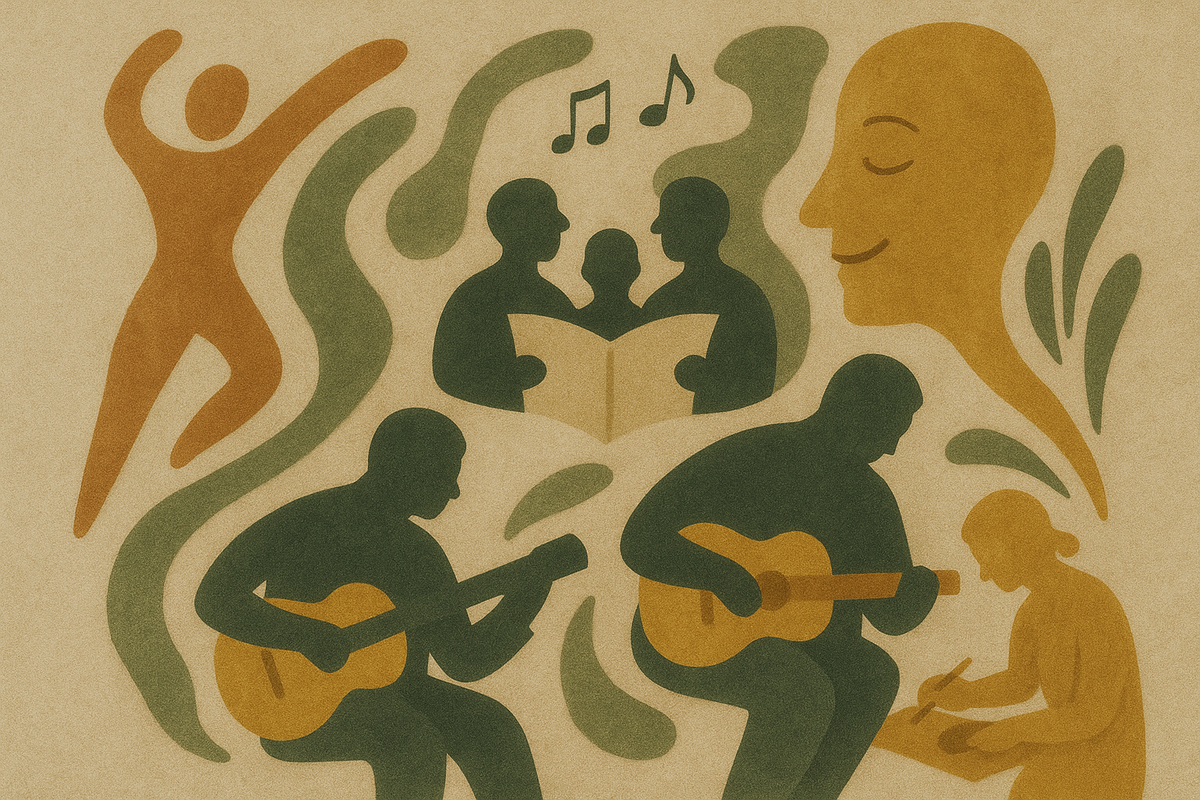
Singing and Music – Breath and Balance for the Mind
Research shows that music activities – whether singing, playing, or listening – significantly improve mental health and quality of life.
A 2022 meta-analysis published in JAMA Network Open, which reviewed more than 20 studies, found that participation in music enhances emotional well-being, reduces stress, and improves physical health indicators.
In the 2024 Italian study “Dedalo Vola”, a 12-week choir program led to better cardiovascular and respiratory function as well as a stronger sense of social belonging among middle-aged and older adults.
These findings confirm that singing is a genuine tool for health promotion, not merely an aesthetic pastime.
Dance – Movement That Connects Body and Emotion
Dance contributes not only to physical fitness but also to emotional equilibrium.
A 2021 study in the International Journal of Qualitative Studies on Health and Well-being demonstrated that dancing fosters emotional expression, creativity, and social connection, helping participants restore harmony between body and mind.
A 2023 review of dance programs for seniors further showed that active dance participation enhances balance, coordination, and cognitive function, while also reducing loneliness and depressive symptoms.
Dance thus becomes a bodily language through which people rediscover vitality and joy.
Craftsmanship – Therapy Through Calm and Focus
Handicrafts and crafts, often regarded simply as hobbies, actually provide significant mental health benefits.
A 2024 systematic review in BMC Psychology found that participation in crafts-based activities reduces anxiety and stress and improves emotional stability.
Participants reported that crafting helps to “quiet the mind,” restore inner calm, and improve concentration.
This creative practice functions as a form of meditation in motion, promoting balance and a sense of belonging within a group.
Theatre – A School of Empathy and Self-Discovery
Taking part in theatre nurtures self-awareness, emotional intelligence, and empathy.
A 2025 study in Youth Studies Australia revealed that young people engaged in theatre activities demonstrated higher levels of empathy, better emotional regulation, and greater self-esteem than those who did not participate in arts programs.
Theatre creates a safe environment where people learn collaboration, trust, and authentic self-expression – skills closely linked to mental health and social integration.
The Power of Community and Public Health
Across all art forms, one element stands out – the sense of belonging.
A 2025 study in Frontiers in Psychology showed that participation in a university choir significantly increased feelings of belonging and emotional well-being among international students.
Similar effects have been found in senior choirs and community arts groups, where regular participation reduces loneliness and increases life satisfaction.
Cultural participation acts as a social immune system, reinforcing trust, empathy, and shared resilience.
Key Impact Indicators (KPI) of Cultural Participation
Cultural engagement generates measurable benefits not only for individuals but also for society as a whole.
People who participate regularly in creative activities exhibit lower stress and burnout levels, greater emotional resilience, and a stronger sense of belonging.
In the workplace, such engagement is linked to better teamwork, higher creativity, and improved job satisfaction, while at the community level it correlates with reduced loneliness and greater social trust.
Together, these factors strengthen public health and contribute to sustainable socio-economic well-being.
Cultural practice is not merely an aesthetic experience – it is an investment in public health.
Singing, dancing, music-making, theatre, and craftsmanship cultivate presence, balance, and connection among individuals and communities.
Science increasingly confirms what artists have long known: creativity heals.
References
- McCrary J. M. et al. (2022). Association of Music Interventions With Health-Related Quality of Life: A Systematic Review and Meta-analysis. JAMA Network Open.
- Viola E. et al. (2024). The Dedalo Vola Project: The effect of choral singing on physiological and psychosocial measures. Acta Psychologica.
- Quiroga Murcia C. et al. (2021). The aesthetic, artistic and creative contributions of dance. International Journal of Qualitative Studies on Health and Well-being.
- Cayton H. et al. (2024). The effects of crafts-based interventions on mental health. BMC Psychology.
- Rourke A. (2025). The mental health and wellbeing outcomes for young people in theatre engagement. Youth Studies Australia.
- Beaton M. et al. (2025). The Impact of Choir Singing on International Students’ Sense of Belonging and Wellbeing. Frontiers in Psychology.
- Fancourt D., & Finn S. (2019). What is the evidence on the role of the arts in improving health and well-being? WHO Regional Office for Europe.
- Clift S., & Camic P. (2020). Oxford Textbook of Creative Arts, Health, and Wellbeing. Oxford University Press.
- Daykin N. et al. (2023). Arts, Culture and Wellbeing: A Systematic Review of Social Impacts. Public Health Reviews.
